How to Start a Career in Embedded Systems in 2026
Nearly every electronic product you touch in a day — your washing machine, your car's dashboard, a fitness band, a smart thermostat — is running on an embedded system. It's one of the few fields in electronics that has only grown more relevant as devices get smarter, not less, and 2026 is a genuinely practical time to start learning it.
This guide covers embedded systems for beginners step by step — what embedded systems actually are, the skills worth learning first, realistic beginner projects, and a practical way to approach the field if you're starting from zero.
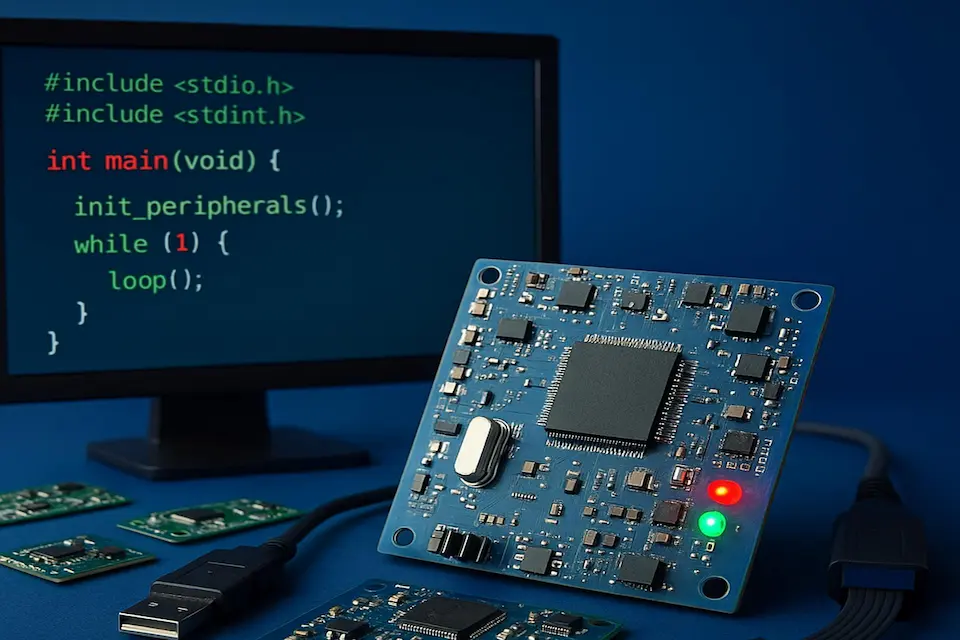
What Are Embedded Systems?
An embedded system is a small computer built into a device to do one job well, rather than run general-purpose software. It usually consists of a microcontroller, some sensors or inputs, and a way to control an output — a motor, a display, a relay.
A few everyday examples:
- The controller inside a washing machine that manages wash cycles
- A car's engine control unit (ECU), managing fuel and ignition timing
- A fitness band reading heart rate and step count
- A smart thermostat adjusting temperature based on a schedule or sensor input
Unlike a laptop or phone, these systems are usually invisible — you interact with the product, not the computer running underneath it.
What Does an Embedded Systems Engineer Do?
The day-to-day work is a mix of hardware and software thinking, which is exactly what makes the field distinct from most programming roles.
- Writing and debugging microcontroller programs
- Developing firmware — the low-level software a device runs on
- Interfacing with sensors and actuators (temperature sensors, motors, relays)
- Working with communication protocols like UART, I2C and SPI
- Integrating hardware and software so they work reliably together
- Debugging and testing on real hardware, not just in a simulator
- Understanding basic electronics well enough to read a circuit and troubleshoot it
Skills You Should Learn for a Career in Embedded Systems
These are the fundamentals worth prioritising, roughly in the order they tend to build on each other:
- C/C++ — the primary languages used in microcontroller programming
- Microcontrollers — understanding registers, memory and interrupts
- Arduino — a beginner-friendly platform for first projects
- ESP32 — for WiFi- and Bluetooth-connected projects
- Raspberry Pi — for projects needing more processing power or Linux
- GPIO — controlling and reading digital pins
- UART, I2C, SPI — the core protocols devices use to talk to each other
- Sensors and actuators — reading inputs and driving outputs reliably
- Basic electronics — circuits, voltage, current, and safe wiring
- Debugging — tracing why hardware or firmware isn't behaving as expected
- IoT fundamentals — connecting embedded devices to the internet
Which Projects Should Beginners Build?
Reading concepts helps, but embedded systems is a field you actually learn by building. A few practical embedded systems projects worth starting with:
Home Automation with Relays
What it does: Controlling lights or appliances remotely.
Technologies: Arduino or ESP32, relay module, WiFi
What you learn: GPIO control, relay switching, basic automation logic
Weather Monitoring Station
What it does: Reading and logging temperature and humidity.
Technologies: ESP32, DHT11/DHT22 sensor, WiFi
What you learn: Sensor interfacing, data logging, WiFi connectivity
Obstacle-Avoiding Robot Car
What it does: A small robot that steers around obstacles.
Technologies: Arduino, ultrasonic sensor, motor driver
What you learn: Sensor reading, motor control, conditional logic
Smart Door Lock
What it does: Access control using a keypad or RFID.
Technologies: Arduino/ESP32, RFID module or keypad, servo/relay
What you learn: Input handling, access logic, actuator control
IoT-Based Plant Watering System
What it does: Automatically waters a plant based on soil moisture.
Technologies: ESP32, soil moisture sensor, water pump, relay
What you learn: Threshold-based automation, sensor calibration
Raspberry Pi Surveillance Camera
What it does: A basic motion-triggered camera system.
Technologies: Raspberry Pi, camera module, PIR sensor
What you learn: Working with Linux-based hardware, camera interfacing
Bluetooth-Controlled LED Panel
What it does: Controlling lighting patterns from a phone.
Technologies: Arduino/ESP32, Bluetooth module, LEDs
What you learn: Serial communication, basic app-to-device control
Arduino vs ESP32 vs Raspberry Pi
These three boards get recommended constantly, but they're not interchangeable — each is genuinely better suited to different kinds of projects.
How to Learn Embedded Systems Step by Step
- Learn basic electronics
- Learn C/C++
- Start with a microcontroller (Arduino is the usual first step)
- Learn GPIO and sensor interfacing
- Learn communication protocols (UART, I2C, SPI)
- Build projects — starting simple, then adding complexity
- Learn to debug hardware and firmware issues methodically
- Build a small project portfolio you can explain and demonstrate
Career Opportunities in Embedded Systems
A solid embedded systems foundation opens into a few related roles. This isn't a promise of employment or placement — just a realistic picture of where these skills are typically applied:
- Embedded Software Developer — writing the code that runs on devices
- Firmware Developer — focused specifically on low-level device software
- Embedded Engineer — a broader role spanning hardware and software
- IoT Developer — building connected, internet-enabled devices
- Hardware/Embedded Engineer — closer to the circuit and component level
Embedded Systems Training in Jalandhar
If you're based in Jalandhar and want to learn this hands-on rather than only through articles and videos, CoderMonk offers Embedded Systems Training in Jalandhar covering microcontroller programming, sensors, communication protocols and practical projects on real hardware.
For students interested in where embedded skills lead next, CoderMonk's Robotics course builds directly on the same sensor and motor control fundamentals covered here.
Those curious about combining embedded systems with intelligent, data-driven behaviour can also look at CoderMonk's AI & Machine Learning course, which covers the modelling side of that pairing in more depth.
More details on CoderMonk's full range of courses are available on the CoderMonk homepage.
Frequently Asked Questions
Is embedded systems difficult for beginners?+
Which programming language is used in embedded systems?+
Is C necessary for embedded systems?+
Should I learn Arduino or ESP32 first?+
Can ECE students learn embedded systems?+
What projects should an embedded systems beginner build?+
What is the difference between embedded systems and IoT?+
Conclusion
Embedded systems rewards patience more than raw talent — the students who make real progress are usually the ones who build consistently, debug their own mistakes, and slowly move from simple LED projects to genuinely useful devices. If you're starting in 2026, the tools and community support are better than they've ever been. The best next step is simply picking a small project and starting.
